
(2 min read)
Last month I performed my full-length comedy show. I felt it from the very first sentence: the audience was in it, and I was in it. Everything flowed. I could play, respond and breathe. My mind did not get in the way. My body knew what to do. To me, it was one great game, and that is why I do it. I felt enormously accepted.
And yet, when I watched the recordings, that old voice returned:
“Here I speak too chaotically.”
“I should have paused there.”
“Why do I move so quickly?”
In the past, that automatically meant: I did something wrong, I have to improve myself.
But the longer I perform and observe — on stage and in my work with others — the clearer it becomes: it is not wrong. It is information.
Your body is always talking.
Your voice, pace, posture and breathing: they are all signals. Often before you have even chosen your words. We cannot not communicate.
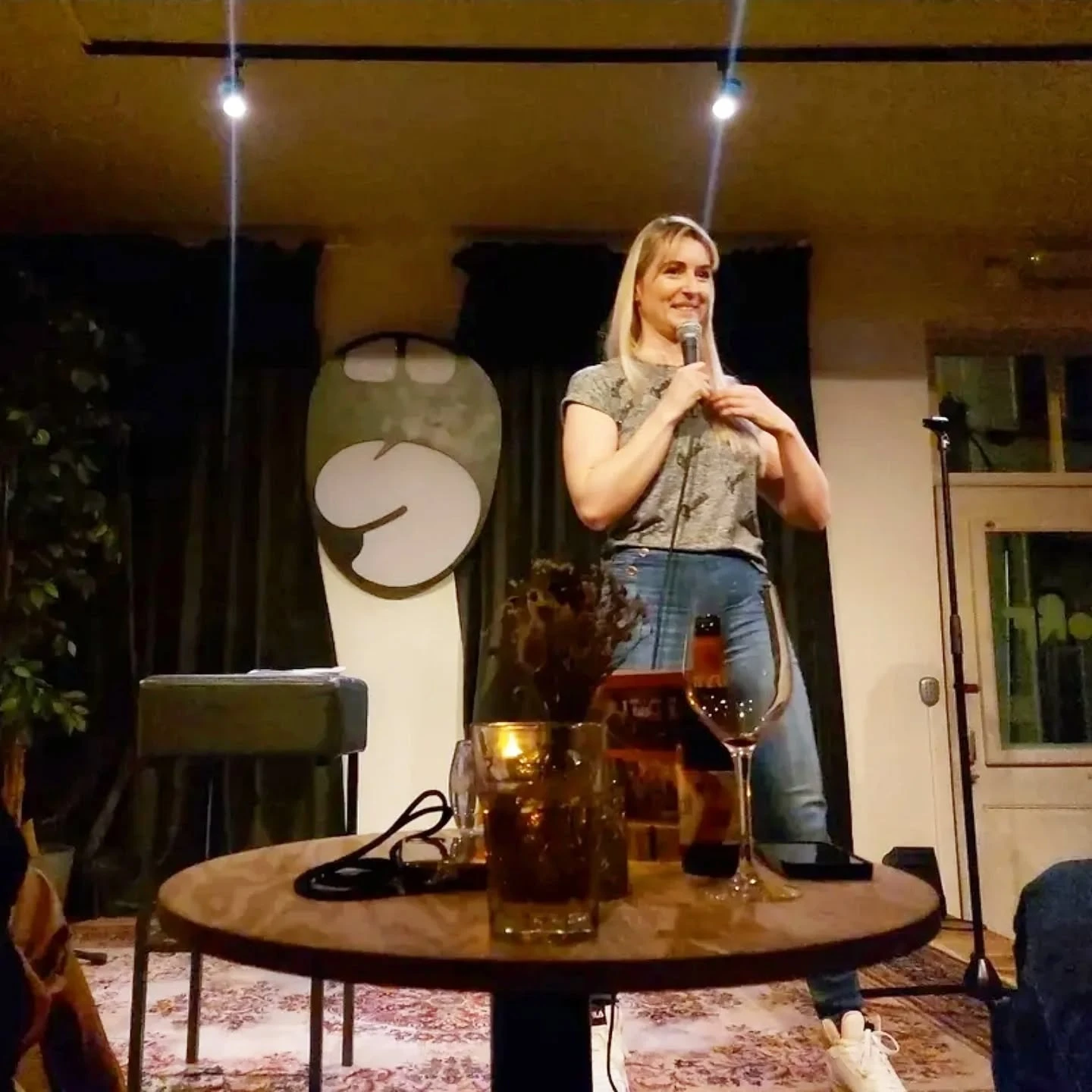
Reflexes on stage
At an open mic in Bruges, I recently lost my timing completely. I had timed everything perfectly: a seven-minute set, with room to spare. But I started interacting with the audience. Play arose. Questions. Improvisation. Before I knew it, I had run over time. My first reflex? Shame.
“Am I too much? Did I take up too much space?”
And then the group photo afterwards: I was standing in the middle. Not out of ego, but because it felt safe there. And still that little voice: “Isn't this too conspicuous?”
But by now I know that it does not matter. My intention was pure. I wanted to share, not dominate. People can feel that. Energy is often clearer than words. Energy does not lie. That is why I like to remind myself of this reassuring quote: “People forget what you said, but they never forget how you made them feel.”

By now, I recognise moments like these as “old reflexes”. The flight or fawn response. I want to disappear or please people. (I talk about the freeze response in the Elektra Podcast.)
But my body does not do things for no reason. It responds to tension. Or to connection. Learning to feel the difference has become essential to me.
Body language as a mirror
In my workshops, we often work with body language before thinking about content. Not in order to “come across well”, but to feel where your body wants to be — and where it does not.
Do you speak quickly? Perhaps you actually want to disappear.
Do you laugh too much? Perhaps you are trying to soothe tension.
Do you stand still like a statue? Perhaps you are protecting yourself.
These are not mistakes. They are signals. And once you recognise them, you do not have to suppress them — you can play with them. Improvisation is a powerful tool for that. Not only because it is funny, but above all because it is honest. You learn to respond to what is happening now, rather than to what you think ought to be happening.

Taking up space is not shouting — it is being present
For me, performing is an exercise in remaining present. Not becoming bigger than I am. But not smaller either. Not rushing towards the laugh, but daring to slow down and ask: am I still here? What touches me most is that those small shifts often have the greatest effect. A pause. A breath. A glance that lingers. Those are the moments that touch the audience most deeply. And they are what I take away with me.
Finally
I am not writing this blog because I know it all. I am writing it because I increasingly realise:
There is no such thing as a “perfect performance”. There is only a body trying to be honest. And when I give that body room — on stage or in my work with people — something magical happens. It is real, and to me that feels tremendous.
Every month I write about the project that has moved me most in my search for more playfulness and authenticity. Next time, I will explain why I can talk very fluently but struggle to find the words when writing. Why is that? I am curious too. Until then!